
This is a collection of the most important resources related to the UDMM.
About
The UDMM was developed from 2024 to 2025 by a task group originating from the consortium of the scientific project Inclusive Digital Application, which was lead by Norsk Regnesentral. It is currently available in version 1.1.
The IDA project is funded by the Research Council of Norway under grant no. 336573.
Terms & definitions

Maturity is the state of progress from an initial phase towards the goal of being perfect.
A maturity model is a framework that helps organizations to plan and assess their current level of maturity in a particular domain, and to identify areas for improvement.
Universal design means the design of products, environments, programmes and services to be usable by all people, to the greatest extent possible, without the need for adaptation or specialized design.
Key features & value
The UDMM has the following key features:
- Applicable to UD work in general and in particular information and communication technology (ICT)
- Supports maturity measurements and next-step recommendations
- Suitable for public, private and non-profit organizations
- Applicable to entire organizatios or sub-units, such as divisions, departments, teams, etc.
- Operable by internal staff and external auditors
- Slim, yet complete
- Free to use (license: CC BY-SA 4.0)
- Developed with sound theoretical foundation, including elements from relevant existing models
- Developed with proper empirical foundation: case-driven, stakeholder involvement, and holistic view
- Current limitation: Not yet validated in the field (this is on-going work)
The UDMM’s main value comes from its features that 1) provide a systematic method to aid measuring how far an organization has come with their UD work, and 2) that help identifying which measures the organization should prioritize to improve their work further.
UDMM overview
Maturity in the UDMM is measured by means of 49 indicators. There are two indicator scales.
- Binary: Not implemented, implemented
- Four-point: Not implemented, barely implemented, mostly implemented, fully implemented
To suppress a given indicator from the model, it can be set to not applicable (NA). For a list of all indicators, please see the reference implementation.
Indicators are grouped logically into six areas, also referred to as dimensions, as depicted below. Universally designed outcomes are the ultimate goal of any UD work. Each of the other areas is a prerequisite for the area before. That is, universally designed outcomes requires the proper resources & means that ease the work, as well as routines & methods into which to embed these resources. How to implement the processes and how to use the resources requires the right competency, and this is in turn built by means of the proper culture. Last but not least, the culture must be enabled by the appropriate backing on the management level.

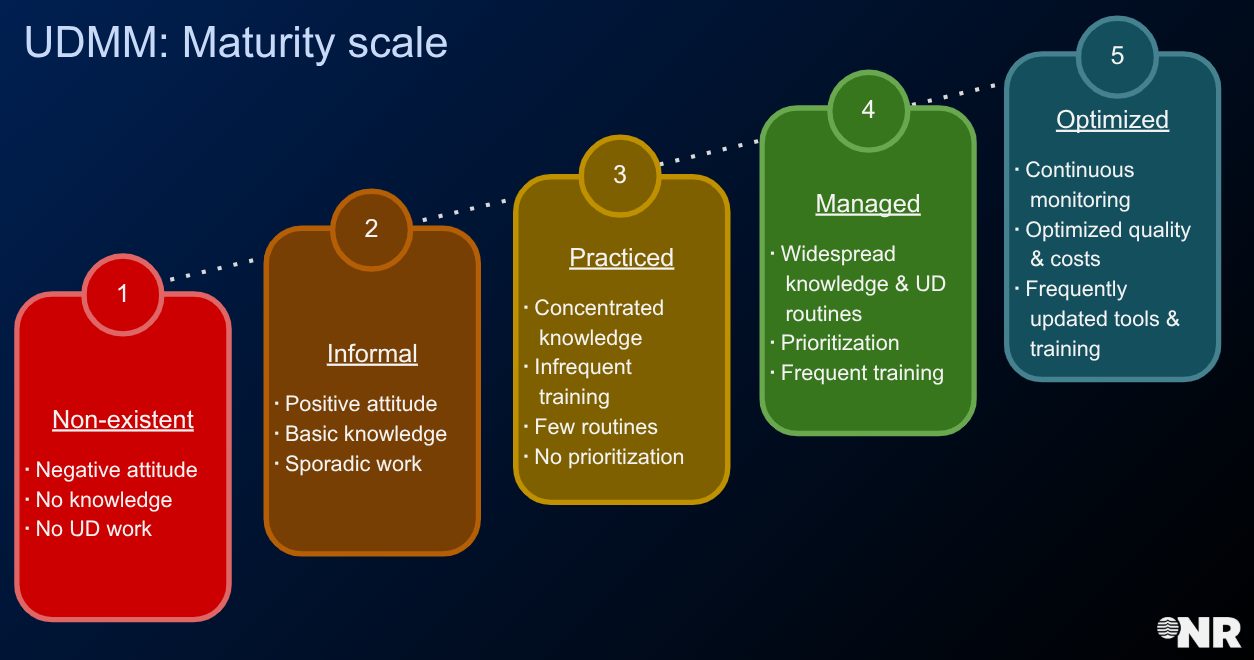
The maturity of an area is calculated by the indicators belonging to this area. The area maturity and the overall maturity have the same scale, depicted below. It consists of the following five levels:
- Non-existent: There is no knowledge about UD and / or a neutral or even negative attitude. Activities might be actively discouraged. UD processes are non-existent.
- Informal: There is a basic understanding of UD and a positive attitude towards relevant activities. Any UD work is non-organized and ad hoc-based.
- Practiced: A few key employees have a fair to good understanding of UD. A few UD work routines exist, but UD is not actively promoted. There may be some (limited) spread of UD knowledge and infrequent educational training. UD-related activities may appear in strategy and planning documents but have not received substantial budgets.
- Managed: There is an at least fair and widespread understanding of UD work in the organization. The majority of management-level employees recognizes the importance of UD-related activities. UD work is part of the organizational strategy and planning, readily implemented and active part of the workflow. Relevant tools are widely used. Sharing of UD knowledge is actively practiced. Employees are frequently educationally trained. Most organizations would target to reach this level.
- Optimized: The quality and costs of UD work are continuously monitored / reviewed and optimized, Both tools and knowledge are frequently updated.

Naturally, the overall maturity is equal to the lowest area maturity.
The UDMM provides also a list of focus indicators. These are the indicators which the organization should focus on / prioritize in order to rise the overall maturity. The focus indicators are those which contribute to the area with the lowest maturity.
For a complete overview of the UDMM, please refer to the official presentation and the scientific articles in the resources section.
Reference implementation
A reference implementation is available as a spreadsheet, please see the resources section. The spreadsheet is supposed to be self-explanatory.
The spreadsheet automatically computes the maturities from the assessment results of all applied indicators by means of a pre-defined mapping of indicator implentation level to indicator maturity. Please see the Indicators sheet for details.
It also shows how complete the evaluation / assessment is (completeness rate).
Yet another feature of the spreadsheet is the compilation of the focus indicator list, as explained above.
Comparisons
The UDMM can be used to compare several organizations with each other regarding their UD work maturity, and it can be used to track a single organization’s progress with its UD work over time.
In both cases, it is crucial that all organizations document in detail how they adapted the UDMM to their needs for any comparison to be valid. This means that each organization should keep track of which indicators were viewed as not applicable, and they should refine the indicator assessment procedure by documenting what exactly was measured, how, and by whom.
How to carry out an assessment
To measure maturity, somebody with good knowledge about the organization of concern needs to go through the indicator list and set a value to each indicator.
A task group of two persons, for instance a leader and an ordinary team member, is often a good idea for the sake of discussing measurement details and values. From experience, the task group may need to ask for input from others for some of the indicators, say, a developer, somebody from the management, or an HR person.
Resources
- Presentation: Till Halbach. The Universal Design of ICT Maturity Model
(UDMM). Presentation at Conference HCII 2025, June 2025. (PDF, 0.5 MB, opens in new tab) NB: Refers to an earlier version (1.0). - Scientific article: Till Halbach, Joschua Thomas Simon-Liedtke, Rudolph Brynn,
Terje André Olsen, and Marius Moe. The Universal Design of ICT Maturity Model (UDMM, opens in new window). In Antona, M., Stephanidis, C. (eds) Universal Access in Human-Computer Interaction. HCII 2025. Lecture
Notes in Computer Science, vol 15780. Springer, June 2025. NB: Refers to an earlier version (1.0). - Scientific article: Till Halbach, Kristin Skeide Fuglerud, and Joschua Thomas
Simon-Liedtke. Towards a model for assessing the maturity of organizations’ work on universally designed digital solutions (opens in new window). In Proceedings of the Seventh International Conference on Universal Design (UD-2024), pages 404–411. iOS, 2024. NB: Refers to an earlier version (1.0). - Spreadsheet: UDMM reference implementation (opens in new window). Works currently only in Google Sheets format.
- Additional documentation is available.